

Italians and “italieschi”
Context: 7 January 2002. The day before, at the Farnesina (the Foreign Ministry), Berlusconi had accused the opposition of «anti-Italian» behaviour5. Grandfather answers as a southerner and as a historian. It is a political polemic of those days, and we report it as such.
To close, grandfather goes back to talking «con se stesso» (“with himself”), as at the beginning (see A1), and looks to the North, «dove io ogni tanto vado, ma dopo una settimana devo partire, tornare qui» (“where I go now and then, but after a week I have to leave, come back here”) (61:07–61:22).7 The North «produce, produce, produce» (“produces, produces, produces”). But what? «Soprattutto oggetti: utilissimi, meno utili e anche inutili» (“Above all objects: very useful, less useful and even useless”). And the list is almost a prose poem: «mobili, occhiali, colori, oggetti, stoffe… bare» (“furniture, glasses, paints, objects, fabrics… coffins”) (61:22–62:21).
«Ma non mi pare che produca idee» (“But it doesn't seem to me to produce ideas”), he says, except through the publishing houses, «nelle quali stampano gli scrittori di tutta Italia» (“in which writers from all over Italy are printed”). Nor, he adds, do the big newspapers produce them, La Stampa and the Corriere della Sera (62:21–62:52). He recalls an article in the Corriere that asked all Italians for «la solidarietà con gli Stati Uniti» (“solidarity with the United States”) (62:52–63:27)1.
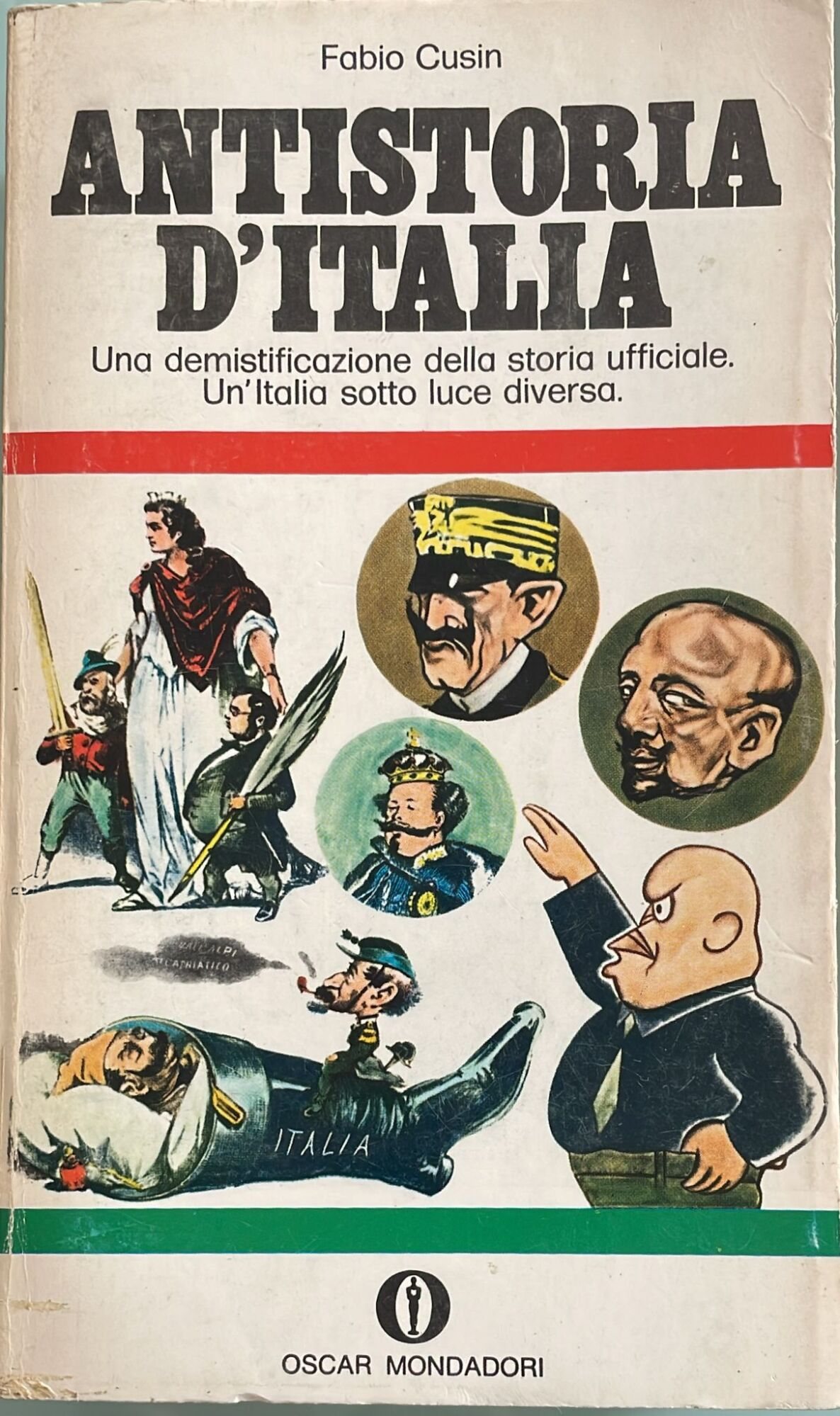
Here the finest formula of the chapter is born: «Ma noi non siamo tutti italiani. Ci sono gli italiani e ci sono gli italieschi» (“But we are not all Italians. There are Italians and there are ‘italieschi’”, would-be Italians) (63:27).8 To explain it he quotes a book: Fabio Cusin, who «ha fatto la storia d'Italia alla rovescia» (“wrote the history of Italy upside down”), the Antistoria d'Italia (63:34)2. Then he lists those who, in his view, were not Italian: those who in the sixteenth century lived by the motto «Francia o Spagna, purché se magna» (“France or Spain, as long as we eat”) [?], those who in the Risorgimento fought «Cavour, Mazzini, Garibaldi», those who served the foreigner, those who were «agli ordini di Hitler» (“under Hitler's orders”). And he asks, with a question that turns everything upside down: «Ma erano italiani quelli che nel corso del Cinquecento alzavano i roghi… bruciavano gli eretici, colpevoli di avere pensato in un modo diverso da come Santa Romana Chiesa aveva indicato?» (“But were they Italians, those who in the course of the sixteenth century raised the stakes… burned the heretics, guilty of having thought differently from how Holy Roman Church had indicated?”) (63:46–64:57)3.
That is why, when Berlusconi calls the opposition leaders, Piero Fassino and Francesco Rutelli, «anti-italiani» (“anti-Italian”), grandfather answers that the word «è stata sempre usata da coloro i quali magari italiani veramente non erano» (“has always been used by those who perhaps were not really Italian”) (64:57–65:35)4.
The close is a wish, «in questo principio di anno» (“at the beginning of this year”). Grandfather quotes Virgil, the Trojans on the night of the fall: «Una salus nullam sperare salutem» (“The one salvation is to hope for no salvation”) (66:06).
Nota: il verso di Virgilio è «Una salus victis nullam sperare salutem» (Eneide II, 354): «l'unica salvezza per i vinti è non sperare alcuna salvezza». Lo dice Enea ai compagni, nella notte in cui Troia brucia6.
Translation Note: Virgil's line is “Una salus victis nullam sperare salutem” (Aeneid II, 354): “the one salvation for the vanquished is to hope for no salvation”. Aeneas says it to his companions, on the night Troy burns.
But grandfather turns it around: «Noi invece vogliamo avere la speranza. Vogliamo tornare ad essere un paese civile, quale fu nei momenti più alti della sua storia, almeno per quanto riguarda l'arte, la cultura. E sono questi veramente i valori con i quali possiamo uscire alla luce da questa disgraziata situazione» (“We, instead, want to have hope. We want to become a civilised country again, as it was in the highest moments of its history, at least as far as art and culture are concerned. And these are truly the values with which we can come out into the light from this wretched situation”) (66:36–67:04). These are the last words of the video.
Video by Orazio Garofalo (opens in a new tab), a friend of Umile Francesco Peluso and his family, published with his permission
Video source: YouTube channel @oraziogarofalorende (opens in a new tab) (uploaded on 9/12/2025). Speaker: Umile Francesco Peluso.
Sources
- Grandfather gives neither title, author nor date. The article he most probably remembers is the editorial by the editor Ferruccio de Bortoli «Siamo tutti americani» (“We are all Americans”), Corriere della Sera, 12/9/2001, which opens with Kennedy's «Ich bin ein Berliner»: giornalistorici.it (opens in a new tab) . The link with grandfather's memory is my own deduction, suggested by the play on «non siamo tutti italiani» (“we are not all Italians”). ↩
- Fabio Cusin, Antistoria d'Italia, Einaudi, Turin 1948 (Biblioteca di cultura storica), written between 1943 and 1944; free text on Liber Liber: liberliber.eu (opens in a new tab) ; Dizionario Biografico dei Trentini: studitrentini.eu (opens in a new tab) ↩
- In the sixteenth century the Roman Inquisition, reorganised by Paul III in 1542, sent to the stake, among others, Pietro Carnesecchi (Rome, 1567) and, at the dawn of the following century, Giordano Bruno (Rome, 17 February 1600). Treccani, «Inquisizione». Grandfather names no names. ↩
- Piero Fassino had been secretary of the Democratici di Sinistra since November 2001; Francesco Rutelli led the Ulivo and the Margherita. Rutelli is in the audio only as «Tutè». ↩
- Radio Radicale, «Berlusconi: conferenza stampa alla Farnesina dopo l'assunzione dell'incarico ad interim di ministro degli esteri», 6/1/2002: radioradicale.it (opens in a new tab) . According to the summary found, Berlusconi spoke of «anti-italiani e masochisti» (“anti-Italian and masochistic”) attitudes of the opposition. ↩
- Virgil, Aeneid, II, 354: it.wikipedia.org (opens in a new tab) ↩
- Context: «Italia del Nord» (“Northern Italy”) (61:16; information from Daniele Calabrese, 22/11/2026); grandfather went there to visit his daughter, in Lombardy. ↩
- «Italieschi» is the word of Giorgio Fenoaltea, Storia degli italieschi dalle origini ai giorni nostri, Florence, G. Barbera, 1945, 337 p. (Catalogo Biblioteche Liguri, record LO10401324; Bibliografia nazionale italiana IT 1946 106). Feltrinelli, used: lafeltrinelli.it (opens in a new tab) . ↩
Books cited
- Antistoria d'Italia Fabio CusinFeltrinelli (opens in a new tab)
- Storia degli italieschi dalle origini ai giorni nostri Giorgio FenoalteaFeltrinelli (opens in a new tab)
- Eneide (II, 354: «Una salus victis nullam sperare salutem») Publio Virgilio MaroneFeltrinelli (opens in a new tab)