

Umile Francesco Peluso
Luzzi, 29 October 1915 – 12 August 2013 · professor and senator
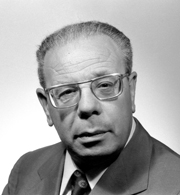
My grandfather, the Professor
In Luzzi they simply called him «il senatore», the senator. For me, and for generations of students at the Liceo Telesio, he was first of all the Professor.
Umile Francesco Peluso was born here, in Luzzi, on 29 October 1915, the only child of a farming family. His father left for the war and fell on 17 November 1915 on Monte San Michele, on the Karst (Carso): my grandfather never knew him. I believe his whole life can be read starting from there, from a fatherless child in a village of the South who finds in books the way to take flight.
The road was not straight. A parish priest sent him to the seminary in Novara, but it was not his vocation. As a war orphan he entered the Nunziatella military school in Naples, but the uniform was not his path either. He stayed in Naples and enrolled in Letters and History, paying for his studies as a tutor at the Collegio dei Poveri in Piazza Carlo III. His mother sold the house so that he could finish. He graduated with a thesis on D'Annunzio's civic poetry. He never forgot that sacrifice, nor his primary-school teacher, Anna Smurra, whom he remembered with gratitude.
Then he taught. Parma, Imperia, Bologna, Rimini, Naples, and finally Cosenza, at the Telesio, where, as was written when he died, he was «un maestro ed un esempio» (“a teacher and an example”) for intellectuals and professionals who had been formed by his learning. In 1950, with Renato Zangheri, he created in Cattolica a prize for dialect poetry with Quasimodo and Eduardo De Filippo on the jury: there a young Pier Paolo Pasolini made his first public appearance. In 1964 he brought the same idea home and founded the Premio Sambucina in Luzzi, with Luciano Anceschi and Francesco Leonetti on the jury. A village in the Crati Valley that calls Italy's critics to read poetry: that was my grandfather.
He was mayor of Luzzi from 1956 to 1964 and again in 1980. When the simplest people of the village remember him, they don't talk about speeches: they talk about the electric light brought to the countryside, the water that reached the outlying districts, the roads that joined the centre to the hamlets. From 1972 to 1979 he was a senator of the Republic, on the Defence and Public Education committees, and he worked on the legal status of teachers. A professor who, once in the Senate, takes care of professors.
In his last years he went back to his first passion. He published two collections of poems, «Alma Poësis» and «Rose di Pieria», and in the foreword to the first he wrote: «Per mio diletto […]. Esercizio letterario o gioco di sillabe e fonemi eletti, lascio che lo dicano gli amici che mi leggeranno» (“For my own delight […]. Literary exercise or a game of chosen syllables and phonemes: I leave it to the friends who will read me to say”). In his house above Luzzi, near the Sambucina, he founded the «Kytérion» Study Centre devoted to the protohistory of Calabria: the ancient time of this valley, the time of the Oenotrians. The house had become a cenacle: people discussed history, archaeology, poetry.
In March 2013 the Municipality of Luzzi awarded him the «Illustri Figli di Luzzi» prize (Illustrious Sons of Luzzi). He died on 12 August of the same year, aged 97, and wished his funeral to be held in the church of Sant'Angelo, in the heart of the old town. My mother took up his legacy with the «Umile Francesco Peluso – Calabria Enotria» Poetry Prize, which reached its tenth edition in 2025.
This library in Luzzi is his too. The books I have read around the world come back to the village he had left with nothing but the will to study. Thank you, Professor.
Video
The video, in 15 articles
- 1“I am what I have done”Minutes 01:03–02:30
- 2“Why I was born”: a farmhands' love story, 1914Minutes 02:30–06:19
- 3The father he never knewMinutes 06:19–07:36
- 4The godfather's letter and the murdered wordMinutes 07:36–09:47
- 5Dante and the uncomfortable truthMinutes 09:47–11:23
- 6Colonialism and the Muslim worldMinutes 11:24–14:03
- 7Violence against the earthMinutes 14:03–16:34
- 8A pope, Poland and memoryMinutes 16:34–23:06
- 9The Church before historyMinutes 23:05–31:57
- 10Machiavelli and sixteenth-century ItalyMinutes 31:57–34:26
- 11Words change, things remainMinutes 34:26–41:04 (Michelangelo 35:54–37:30)
- 1211 September and the “end of history”Minutes 41:04–46:57
- 13Religious radicalism and the long view of historyMinutes 46:57–53:27
- 14One world: globalisation, control, hatredMinutes 53:32–61:07
- 15Italians and “italieschi”Minutes 61:07–67:04
Sources
- ICSAIC, Dizionario biografico, «Peluso, Umile Francesco» (S. Corchiola, 2020) (opens in a new tab)
- Corriere della Calabria, 13/08/2013
- Senato della Repubblica, schede VI e VII legislatura (opens in a new tab)
- Albo d'oro dei caduti 1915–18, vol. IV Calabria, p. 485 (opens in a new tab)
- S. Corchiola, «Figli di Calabria», 03/09/2013
Show all sources (6)
- CosenzaPost, 12/10/2025