

11 September and the “end of history”
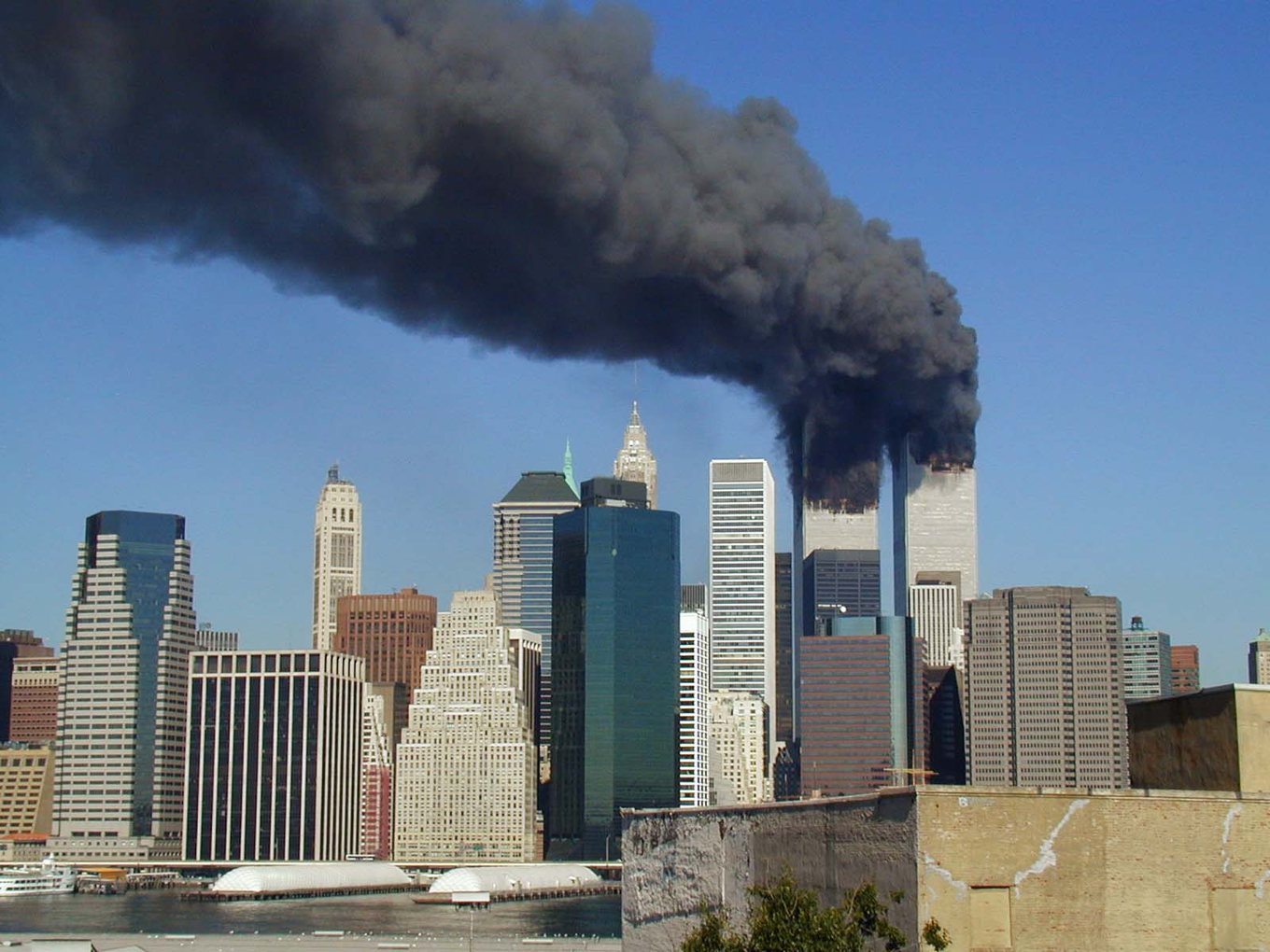
Context: four months have passed since 11 September 2001. Grandfather reads the attacks through the books he knows and the newspapers of those days. The thesis of a Pentagon that is «looking for the enemy» is his political reading, not an established fact: we present it as such, with the sources alongside.
To talk about the Twin Towers grandfather takes a book from the shelf of his memory: «Lo scambio simbolico e la morte» (“Symbolic Exchange and Death”), «a pagina 82, me la ricordo perché me la rivedo sempre» (“on page 82, I remember it because I keep looking at it again”), a book from 1979, published, he thinks, by Feltrinelli (41:04–41:58). It is Jean Baudrillard's essay, which came out in Paris in 1976 and was translated by Feltrinelli in 19791. Grandfather sums up its idea: the skyscrapers of capitalism grew «sempre più alti, ma diseguali» (“ever taller, but unequal”), like the towers of the families in medieval Bologna. Then «qualcuno pensa di costruire due grattacieli uguali: non ci dovrà essere più concorrenza» (“someone thinks of building two identical skyscrapers: there must be no more competition”) (41:58–42:55).
The memory is faithful. Baudrillard asked why the World Trade Center had two towers, when all the skyscrapers of Manhattan had always confronted each other «in una verticalità concorrenziale» (“in a competitive verticality”). And he answered that the «duopolio» (“duopoly”) is the completed stage of monopoly2.
Nota: le parole esatte di Baudrillard, alle pp. 82–83 dell'edizione Feltrinelli, sono: «Perché ci sono due torri al World Trade Center di New York? Tutti i grandi buildings di Manhattan si sono sempre accontentati di affrontarsi in una verticalità concorrenziale… Questo grafismo architettonico è quello del monopolio: le due torri del WTC… il fatto che ve ne siano due identiche significa la fine di qualsiasi concorrenza, la fine di qualsiasi referenza originaria»1. Il paragone con le torri di Bologna è di nonno.
Translation Note: Baudrillard's exact words, on pp. 82–83 of the Feltrinelli edition, are: “Why are there two towers at the World Trade Center in New York? All the great buildings of Manhattan had always been content to confront each other in a competitive verticality… This architectural graphism is that of monopoly: the two towers of the WTC… the fact that there are two identical ones signifies the end of all competition, the end of all original reference”. The comparison with the towers of Bologna is grandfather's.
After 11 September it was Baudrillard himself who came back to those towers, in The Spirit of Terrorism3.
From here grandfather moves to another famous idea: «La storia è finita, dirà quel giapponese» (“History is over, that Japanese man will say”) (42:55).
Nota: l'autore corretto è Francis Fukuyama, politologo statunitense di origine giapponese: «The End of History?» (1989), poi La fine della storia e l'ultimo uomo (1992)4.
Translation Note: the correct author is Francis Fukuyama, an American political scientist of Japanese descent: “The End of History?” (1989), then The End of History and the Last Man (1992).
In grandfather's reading, the towers had to fall «per rimettere in moto la storia» (“to set history in motion again”). He also tells, cautiously («mi è stato detto, io non l'ho visto», “I was told, I haven't seen it”), of American cartoons in which the game was to bring down the towers (43:10–43:42)5.
Then he compares two voices. «Il giorno dopo Chomsky scrisse: quello che è stato compiuto non è un atto di guerra, è un atto criminale, e bisogna rispondere con un tribunale internazionale» (“The next day Chomsky wrote: what has been done is not an act of war, it is a criminal act, and the answer must be an international tribunal”) (44:12–44:40). On 12 September Noam Chomsky spoke of «crimini orrendi» (“horrendous crimes”). The distinction between a crime and an act of war, and the reference to international law and the Hague Court, are in the interviews of the following weeks, collected in 11 settembre. Le ragioni di chi? (9-11)6. The other voice is that of Edward Luttwak, who «dieci anni prima» (“ten years earlier”) supposedly pointed to the Muslim world as «il più grande nostro nemico» (“our greatest enemy”) (44:40)7. Hence grandfather's thesis: the Pentagon had «uno scenario» (“a scenario”) ready, and 11 September was «l'occasione» (“the opportunity”) for the war, which «sarà infinita» (“will be endless”) (45:03–45:55).
The last quotation is from a journalist: «Il 12 settembre, sulla Stampa di Torino, un notista che scrive di solito in prima pagina, Gramellini» (“On 12 September, in La Stampa of Turin, a columnist who usually writes on the front page, Gramellini”), wrote: «Se gli Stati Uniti non riusciranno a cocacolizzare militarmente gli arabi, dovranno venire a patti con noi» (“If the United States does not manage to Coca-Colonise the Arabs militarily, it will have to come to terms with us”) (45:55–46:41)8. And grandfather announces the «stampa più avvertita e più intelligente» (“more aware and more intelligent press”) of those days, which opens the next chapter (A13).
Video by Orazio Garofalo (opens in a new tab), a friend of Umile Francesco Peluso and his family, published with his permission
Video source: YouTube channel @oraziogarofalorende (opens in a new tab) (uploaded on 9/12/2025). Speaker: Umile Francesco Peluso.
Sources
- Jean Baudrillard, L'échange symbolique et la mort, Gallimard, Paris 1976; Italian translation by G. Mancuso, Lo scambio simbolico e la morte, Feltrinelli, Milan 1979. The passage on the two towers is on pp. 82–83: M. Biraghi, «L'architettura come sistema di differenze», Gizmo, 26/1/2013, quotes it in full from the 1984 Feltrinelli edition, pp. 82–83 (gizmoweb.org (opens in a new tab)). The page grandfather gives, 82, is correct. Edition in print: Feltrinelli, Universale Economica, ISBN 9788807886508. ↩
- The 1976 passage is quoted and summarised in Ludovic Leonelli, La Séduction Baudrillard, École nationale supérieure des Beaux-Arts, 2007, pp. 133–140, taken up in bourbakisme.blogspot.com (opens in a new tab) («Tous les grands buildings de Manhattan se sont toujours contentés de s'affronter dans une verticalité concurrentielle…»; duopoly as the «stade achevé du monopole»). The comparison with the towers of Bologna is grandfather's. ↩
- Jean Baudrillard, L'esprit du terrorisme, Le Monde, 2 November 2001; Italian edition Lo spirito del terrorismo, Raffaello Cortina, ISBN 9788870787504. ↩
- Francis Fukuyama, «The End of History?», The National Interest, summer 1989; The End of History and the Last Man, 1992. Italian edition in print: UTET, ISBN 9791221207521. ↩
- [not verifiable] Grandfather himself says he did not see them. ↩
- Noam Chomsky, «A Quick Reaction», CounterPunch, 12/9/2001 («horrendous crimes»). On 11 September as a crime and not an «attacco armato» (“armed attack”): interview by Suzy Hansen, Salon, 16/1/2002, chomsky.info (opens in a new tab) ; collection 9-11, Seven Stories, 2001; Italian edition 11 settembre. Le ragioni di chi?, Marco Tropea, ISBN 9788843803620. Grandfather's words are his own summary. On the judicial response: in his MIT lecture of 18/10/2001, «The New War Against Terror», Chomsky says: «The way to deal with it was pretty much what they did. You know, find the perpetrators; bring them to trial; and look for the reasons» (chomsky.info (opens in a new tab)). In the interview with Radio B92 of September 2001 he says that the evidence of bin Laden's role should be enough to hand him over for trial in the United States «or an international tribunal» (from the summary of a search; full text not read). Grandfather's phrase («rispondere con un tribunale internazionale», “answer with an international tribunal”) corresponds in substance. The «giorno dopo» (“next day”) applies to “crime” (12/9), not to the tribunal. ↩
- Luttwak, in several interviews, on the «inferiorità competitiva» (“competitive inferiority”) of the Islamic world compared with the West (which generates humiliation and feeds fundamentalism); sources: milanopost.info (opens in a new tab) ; almanacco.cnr.it (opens in a new tab) ; it.wikiquote.org (opens in a new tab) (information from Daniele Calabrese, 22/11/2026). ↩
- Massimo Gramellini, «Buongiorno», front-page column in La Stampa, 12/9/2001; sources: rivistastudio.com (opens in a new tab) ; it.wikipedia.org (opens in a new tab) (information from Daniele Calabrese, 22/11/2026). ↩
Books cited
- Lo scambio simbolico e la morte Jean BaudrillardFeltrinelli (opens in a new tab)
- Lo spirito del terrorismo (lettura di contesto, non citata da nonno) Jean BaudrillardFeltrinelli (opens in a new tab)
- La fine della storia e l'ultimo uomo Francis FukuyamaFeltrinelli (opens in a new tab)
- Lo scontro delle civiltà e il nuovo ordine mondiale (contesto, non citato da nonno) Samuel P. HuntingtonFeltrinelli (opens in a new tab)
- 11 settembre. Le ragioni di chi? Noam ChomskyFeltrinelli (opens in a new tab)