

Colonialism and the Muslim world
Context: grandfather is speaking on 7 January 2002, four months after 11 September. For three months the United States and its allies have been bombing Afghanistan. This is the voice of a left-wing intellectual of those days: we report it in full, with the checked facts alongside.
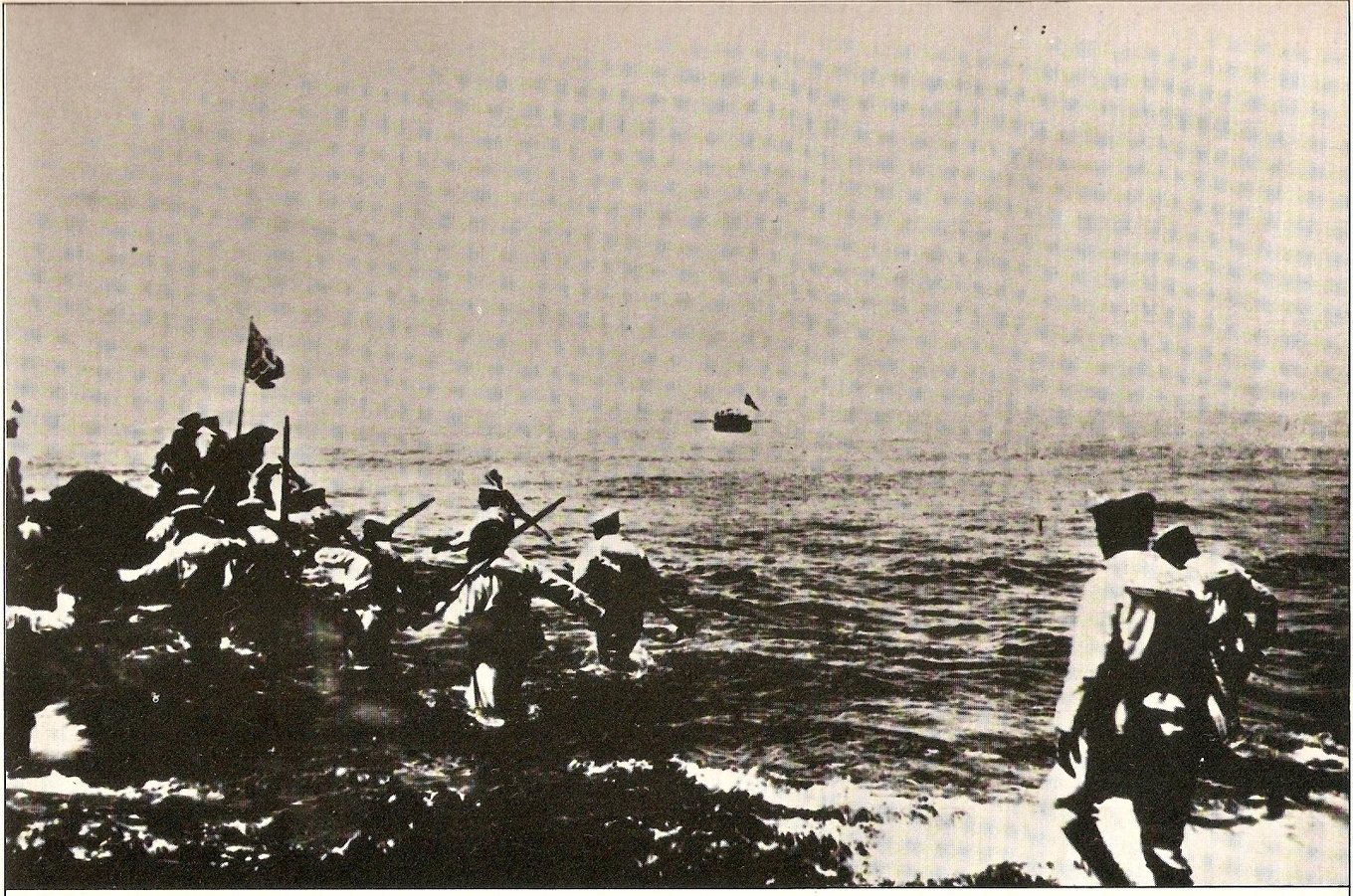
Having finished with Dante, grandfather moves on to the century that has just ended, and makes it begin in Africa. «Ora, questo nostro tempo si è aperto con i massacri della Libia, dove i nostri gloriosi soldati andavano cantando "Tripoli, bel suol d'amore"» (“Now, this time of ours opened with the massacres in Libya, where our glorious soldiers went singing ‘Tripoli, beautiful land of love’”) (11:27–11:46)1. The song by Giovanni Corvetto and Colombino Arona premiered in Turin on 8 September 1911, three weeks before the declaration of war on the Ottoman Empire2. On 23 October 1911, at Shar al-Shatt (Sciara Sciat), in the oasis of Tripoli, a Turkish-Arab attack cost the lives of almost four hundred Italian soldiers; a very harsh repression followed, with executions and deportations of Libyans to Italian islands3.
For grandfather that war has a precise logic: «L'Italia è arrivata ultima nella spartizione del mondo, dell'Africa, di quello che sarebbe stato il mondo coloniale, ora farà anche la sua parte di leone» (“Italy arrived last in the carving-up of the world, of Africa, of what would become the colonial world; now it too will take the lion's share”) (11:46–12:03).
Then comes the strongest sentence of the chapter. «Quando bin Laden parla, non è che delira, come scrivono i nostri giornali. Dice cose anche storicamente accertate, quando dice che da ottant'anni il mondo musulmano è sotto il peso di una servitù che gli impone il mondo occidentale» (“When bin Laden speaks, he is not raving, as our newspapers write. He also says things that are historically established, when he says that for eighty years the Muslim world has been under the weight of a servitude imposed on it by the Western world”) (12:03–12:27). Grandfather is referring to the video message of 7 October 2001, the day the bombing of Afghanistan began. In it bin Laden says that the Islamic «nazione» (“nation”) has suffered «questa umiliazione e questa degradazione da più di ottant'anni» (“this humiliation and this degradation for more than eighty years”)4.
Grandfather explains at once what he means: «quegli anni in cui l'impero ottomano finiva e gli Stati d'Europa, Italia compresa, ma soprattutto Francia e Inghilterra, si buttavano su queste terre arabe e se le spartivano» (“those years when the Ottoman Empire was ending and the States of Europe, Italy included, but above all France and England, threw themselves on these Arab lands and divided them up”) (12:27–12:55). Here history proves him right. With the Sykes-Picot agreement of 1916 France and Britain divided the Arab provinces of the Empire in advance. The San Remo conference of 1920 assigned the mandates: Syria and Lebanon to France, Palestine and Mesopotamia to Britain5. In grandfather's sentence what is «storicamente accertato» (“historically established”) is the division of the Arab lands. At this point he is not talking about the attacks, and his sentence must not be read as a justification of them.
Colonialism, he adds, is not only Arab. «Non dimentichiamoci del modo grazioso come trattava gli indiani» (“Let us not forget the gracious way it treated the Indians”), he says of England, «ce lo dice Gandhi. Gli eleganti ufficiali inglesi usavano anche legare i ribelli indiani alla bocca dei cannoni e sparare» (“Gandhi tells us. The elegant English officers also used to tie Indian rebels to the mouths of cannons and fire”) (12:55–13:27). It is a documented fact: after the 1857 rebellion the British executed many rebels by «blowing from a gun», tying them in front of the cannon's mouth6.
The final judgement is a historian's, not a partisan's. The West «ha una grande storia alle spalle» (“has a great history behind it”), above all in the Middle Ages and the Renaissance, but «le infamie maggiori le ha commesse nell'Ottocento e nel Novecento» (“it committed its greatest infamies in the nineteenth and twentieth centuries”). And «la più grande e ultima infamia è questa guerra contro le montagne» (“the greatest and latest infamy is this war against the mountains”) (13:27–14:03): Afghanistan, to which the next chapter is devoted (A7).
Video by Orazio Garofalo (opens in a new tab), a friend of Umile Francesco Peluso and his family, published with his permission
Video source: YouTube channel @oraziogarofalorende (opens in a new tab) (uploaded on 9/12/2025). Speaker: Umile Francesco Peluso.
Sources
- Title of the song confirmed by ear (11:38; information from Daniele Calabrese, 22/11/2026). ↩
- Wikipedia, «A Tripoli» (first performance at the Teatro Balbo in Turin, 8 September 1911, with Gea della Garisenda; war declared on 29 September 1911): it.wikipedia.org (opens in a new tab) ; lyrics on Wikisource: it.wikisource.org (opens in a new tab) ; Storia e Memoria di Bologna, «Gea della Garisenda»: storiaememoriadibologna.it (opens in a new tab) ↩
- Treccani, «italo-turca, guerra»: treccani.it (opens in a new tab) ; Sapere.it (De Agostini), «Sciara Sciat» (370 soldiers and 8 officers killed; «durissima repressione da parte italiana», “very harsh repression by the Italians”): sapere.it (opens in a new tab) ; on the deportations (Tremiti, Ustica, Ponza): it.wikipedia.org (opens in a new tab) ↩
- Text of the message of 7/10/2001, The Guardian: «Our nation has been tasting this humiliation and this degradation for more than 80 years»: theguardian.com (opens in a new tab) ; also BBC News: news.bbc.co.uk (opens in a new tab) ↩
- Treccani, «Medio Oriente» (Enciclopedia Italiana): treccani.it (opens in a new tab) ; Treccani, «Sanremo, Conferenza di»: treccani.it (opens in a new tab) ; Treccani Atlante geopolitico, «1916-2016: come cambia il Medio Oriente a cent'anni da Sykes-Picot». Italy obtained Libya from the Ottomans (1912) and the Dodecanese, not Arab mandates. ↩
- National Army Museum, London, «Mutineers about to be blown from guns by the Bengal Horse Artillery, 1858»: collection.nam.ac.uk (opens in a new tab) ; Wikipedia, «Blowing from a gun»: en.wikipedia.org (opens in a new tab) . The historical context of the sentence is «blowing from a gun», the execution of rebels tied to the mouth of a cannon used by the British after 1857 (information from Daniele Calabrese, 22/11/2026). The reference to Gandhi is grandfather's attribution: the precise passage in which Gandhi describes this practice has not been found. In Hind Swaraj (1909), chapter XVII, Gandhi uses the image of the cannon in another sense: the passive resister accepts even being «blown to pieces at the mouth of a cannon» (mkgandhi.org (opens in a new tab)). This may be what grandfather remembered, but it is my hypothesis. ↩