

“Why I was born”: a farmhands' love story, 1914
«Io sono nato perché un giovane calabrese, bracciante, nel 1914, in un paese della Calabria, si era innamorato di una giovane contadina» (“I was born because a young Calabrian farmhand, in 1914, in a village in Calabria, had fallen in love with a young peasant woman”) (02:30). This is how grandfather tells his origin. He does not start from a family tree. He starts from a love between poor people.
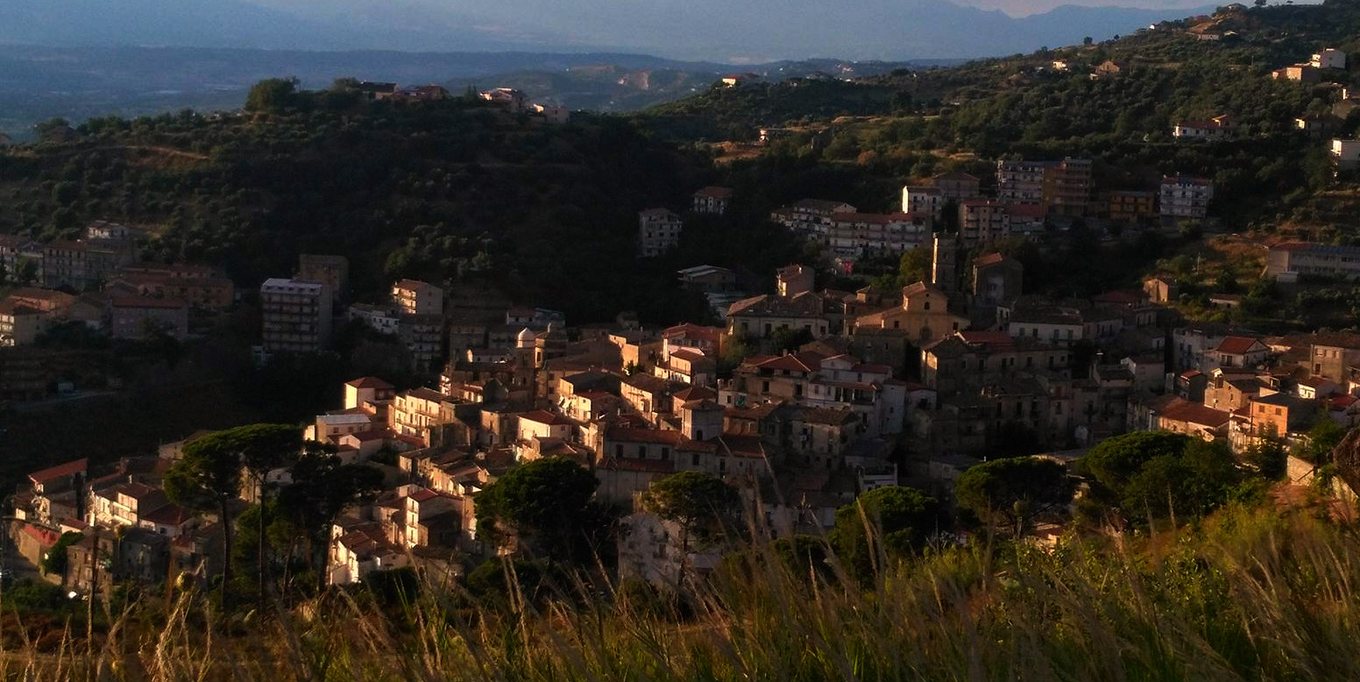
The village is Luzzi, in the Crati Valley. The two young people, according to his biography, are Salvatore Peluso and Maria Cristina D'Amico, peasants1. In the video grandfather does not say their names: he says their ages. «Lui aveva 24 anni, la giovane ne aveva 21. Era contadina anche lei e andava a giornata» (“He was 24, the young woman was 21. She was a peasant too and worked by the day”) (03:01–03:08). Working «a giornata» (“by the day”) means working other people's land, paid day by day.
Nota: il fatto corretto è che, secondo l'Albo d'oro, il padre era nato il 24 agosto 1891: nel 1914 aveva 22–23 anni (Albo d'oro dei caduti, vol. IV Calabria, p. 485).
Translation Note: the correct fact is that, according to the Albo d'oro (Roll of Honour), the father was born on 24 August 1891: in 1914 he was 22–23 years old (Albo d'oro dei caduti, vol. IV Calabria, p. 485).
Love meets an obstacle at home. The young man's mother does not want the marriage. Grandfather remembers her in very harsh words, «una sorta di strega egoista» (“a sort of selfish witch”), and adds: «posso dirlo perché l'ho conosciuta» (“I can say so because I knew her”) (03:24–03:38)2. He also explains her reasons: «sia perché perdeva il figlio che portava a casa i soldi, sia perché era gelosa che un'altra donna, giovane, lo avesse per sé, sia per altri motivi probabilmente che non voglio dire» (“both because she was losing the son who brought money home, and because she was jealous that another woman, a young one, should have him for herself, and probably for other reasons I don't want to say”) (03:38–04:09). In a family of farmhands a son who works is also a wage, and grandfather says so without beating about the bush.
The young man's father, on the other hand, is almost a figure out of a tale: «Il padre era un buon uomo, una specie di rabdomante, che campava tanto di qua e di là nelle campagne, cercando anche monete antiche» (“The father was a good man, a kind of water diviner, who scraped a living here and there in the countryside, also looking for ancient coins”) (06:00–06:13). A water diviner looking for ancient coins. One thinks of the love of archaeology that would lead grandfather to found the «Kytérion» Study Centre3. That link is only ours: grandfather does not make it in the video.
Meanwhile war has broken out in Europe. Grandfather remembers: «la guerra era iniziata nel '14, nell'agosto del '14» (“the war had begun in '14, in August '14”) (04:28). Italy is still neutral and will enter the war on 24 May 19154.
Nota: il fatto corretto è che la guerra cominciò il 28 luglio 1914, con la dichiarazione dell'Austria-Ungheria alla Serbia; ai primi di agosto entrarono in guerra Germania, Russia, Francia e Regno Unito (Treccani, «Prima guerra mondiale»: treccani.it (opens in a new tab)).
Translation Note: the correct fact is that the war began on 28 July 1914, with Austria-Hungary's declaration of war on Serbia; in early August Germany, Russia, France and the United Kingdom entered the war (Treccani, «Prima guerra mondiale», First World War).
One evening, at the beginning of 1915, after «un violentissimo alterco» (“a very violent quarrel”), the young man goes out into the street, looks at the sky and shouts: «Gesù, se vado in guerra… voglio morire per primo, però voglio lasciare qualcuno!» (“Jesus, if I go to war… I want to die first, but I want to leave someone behind!”) (04:28–05:13).
The real sentence was in dialect. Grandfather sums it up like this: «Voglio lasciare, in sostanza, un germoglio» (“In short, I want to leave a sprout”) (05:40)5. And the young man «si sposò contro la volontà della madre» (“married against his mother's will”) (05:53).
That sprout is him. That is why, at the beginning, grandfather can say: «Io so perché sono nato, e so quindi chi sono» (“I know why I was born, and so I know who I am”).
Video by Orazio Garofalo (opens in a new tab), a friend of Umile Francesco Peluso and his family, published with his permission
Video source: YouTube channel @oraziogarofalorende (opens in a new tab) (uploaded on 9/12/2025). Speaker: Umile Francesco Peluso.
Sources
- Biography «Luzzi – Tebe Lucana»: luzzi---tebe-lucana.webnode.it (opens in a new tab) ; ICSAIC, «Peluso, Umile Francesco»: icsaicstoria.it (opens in a new tab) . In the Albo d'oro dei caduti (Roll of Honour of the fallen) the father is written as «Piluso Salvatore di Vito» (see A3). ↩
- The judgement on his paternal grandmother is grandfather's own, said in public. The quotation «una sorta di strega egoista» is kept by decision of the family (Daniele, 22/11/2026). ↩
- The «Kytérion» Study and Research Centre, devoted to Calabrian protohistory: biography «Luzzi – Tebe Lucana» (link above). The public text must not say where it is. ↩
- Treccani, «Prima guerra mondiale»: after the Treaty of London of 26 April 1915, «la guerra all'Austria fu dichiarata il 24» maggio (“war on Austria was declared on the 24th” of May). treccani.it (opens in a new tab) ↩
- At 05:49 grandfather repeats the dialect word. The transcriptions give «Nucchiantone» or «Nuciantone»: almost certainly «nu chiantune», «un piantone», that is, a seedling. In a dialect poem from San Fili (Cosenza), «nu bellu chiantune» is a sapling grown from a chestnut, and «nu chiantunieddru» means, figuratively, «un figlio» (“a son”) (Pietro Perri, «U Catanànnu 'e su paise», 2016: sanfilibypietroperri.blogspot.com (opens in a new tab)). [spelling to be confirmed by ear by a speaker of the Luzzi dialect] In the text I use grandfather's own translation, «un germoglio» (“a sprout”). ↩