

The father he never knew
The marriage comes quickly, like the war. «Si sposò con questa giovane che sarebbe stata mia madre, nel gennaio del '15. Partì per la guerra nel marzo del '15» (“He married this young woman who would become my mother, in January '15. He left for the war in March '15”) (06:19–06:30). Two months later Italy enters the conflict1.
The son is born in the autumn: «Io nacqui nell'ottobre del '15, alla fine di ottobre» (“I was born in October '15, at the end of October”) (06:37–06:42). It is 29 October 19152.
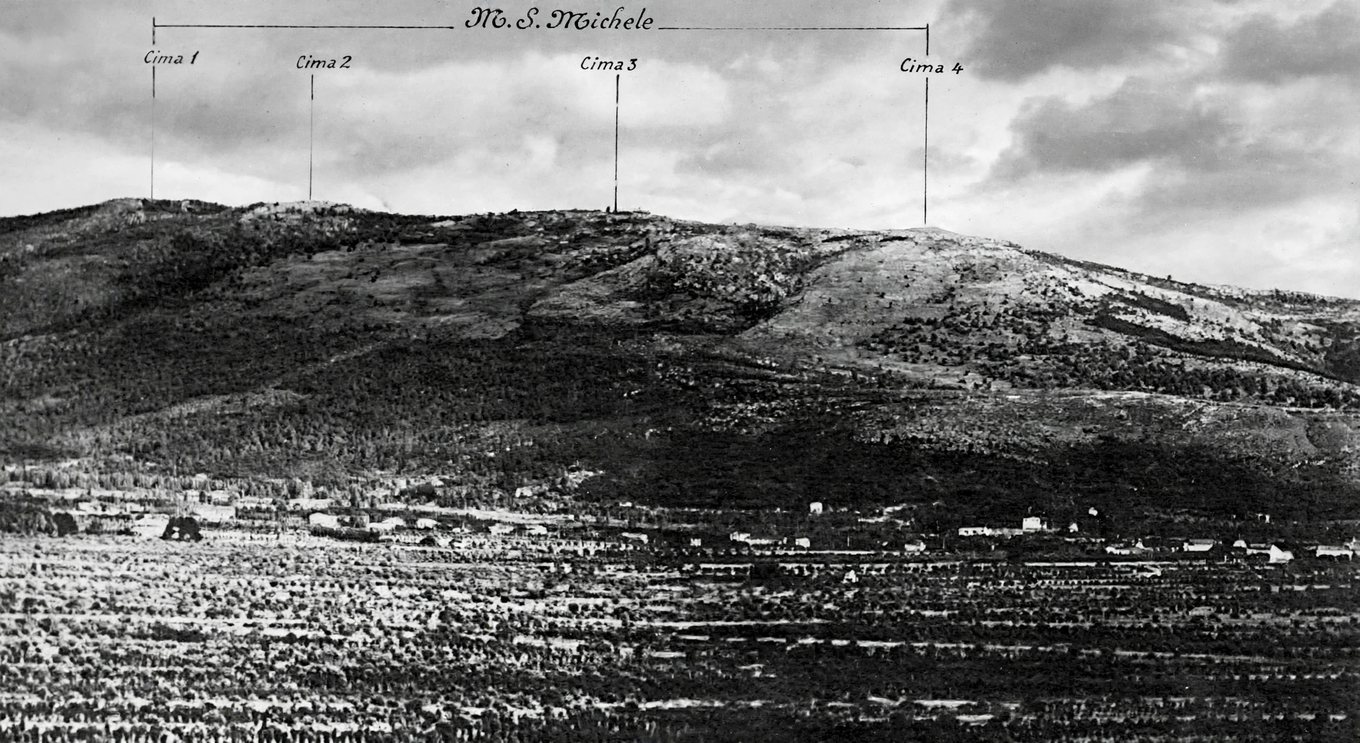
At the front, meanwhile, the father is with the infantry on the Karst, facing Monte San Michele. The Albo d'oro of the fallen of the Great War records him like this: corporal of the 19th Infantry Regiment, born in Luzzi on 24 August 1891, military district of Cosenza, «morto il 17 novembre 1915 sul Monte San Michele per ferite riportate in combattimento» (“died on 17 November 1915 on Monte San Michele of wounds received in combat”)3. The 19th Infantry belonged to the «Brescia» Brigade, which in those days, during the Fourth Battle of the Isonzo, was attacking peaks 3 and 4 of the San Michele and lost about 2,500 men there4.
Nota: nel video nonno dice «17 settembre del '15» (06:44). La data corretta è il 17 novembre 1915 (Albo d'oro dei caduti, vol. IV Calabria, p. 485).
Translation Note: in the video grandfather says “17 September '15”. The correct date is 17 November 1915 (Albo d'oro dei caduti, vol. IV Calabria, p. 485).
Grandfather tells of his father's death like this: «Però aveva saputo che era nato… che gli era nato un figlio. Poteva quindi morire. Difatti morì» (“But he had learnt that he was born… that a son had been born to him. So he could die. And in fact he died”) (06:51–07:07). The date in the Albo d'oro confirms this memory: the father dies nineteen days after his son's birth, long enough for the news to reach the trench.
Then grandfather says how he died, and it is the bitterest passage: «Ucciso dalla nostra artiglieria, perché erano così bravi i nostri artiglieri, sul San Michele, che invece di sparare sugli austriaci spararono sulla nostra prima linea. E mio padre era in prima linea, pronto all'attacco» (“Killed by our own artillery, because our gunners on the San Michele were so good that instead of firing on the Austrians they fired on our front line. And my father was in the front line, ready to attack”) (07:11–07:35)5.
Umile Francesco Peluso will grow up without a father. As a war orphan he will enter the Nunziatella in Naples6. In 2002, at eighty-six, he speaks of it with the cutting irony of a man who spent his life distrusting rhetoric: «così bravi, i nostri artiglieri» (“so good, our gunners”).
Video by Orazio Garofalo (opens in a new tab), a friend of Umile Francesco Peluso and his family, published with his permission
Video source: YouTube channel @oraziogarofalorende (opens in a new tab) (uploaded on 9/12/2025). Speaker: Umile Francesco Peluso.
Sources
- Treccani, «Prima guerra mondiale»: war on Austria was declared on 24 May 1915. treccani.it (opens in a new tab) ↩
- Senate of the Republic, Peluso record (6th legislature): senato.it (opens in a new tab) ↩
- Albo d'oro dei militari caduti nella guerra nazionale 1915–1918, vol. IV, Calabria, p. 485, entry «Piluso Salvatore di Vito». ISTORECO database: cadutigrandeguerra.it (opens in a new tab) (search «Piluso Salvatore», municipality Luzzi). In the Albo the surname is spelt «Piluso». The family confirmed that grandfather's father was called Piluso, son of Vito, so the entry in the Albo is his (Daniele, 22/11/2026). ↩
- Museo civico del Risorgimento di Bologna, «Storia e Memoria di Bologna», record «Fanteria – 19° e 20° reggimento, brigata Brescia» (from the Riassunti storici dei corpi e comandi, Historical Office of the Army General Staff): storiaememoriadibologna.it (opens in a new tab) ↩
- The father's death under fire from our own artillery is grandfather's account, as it reached the family. There is no documentary confirmation: the Albo d'oro only says «per ferite riportate in combattimento» (“of wounds received in combat”). It is, however, an entirely plausible account. “Short shots” of one's own artillery falling on the front lines were frequent in the Great War on the Italian front. A documented example: on 19 June 1917, in the attack on Monte Mosciagh, on the infantrymen of the 112th Regiment «iniziarono a cadere i tiri corti della nostra artiglieria» (“the short shots of our artillery began to fall”) (Museo civico del Risorgimento di Bologna, «Storia e Memoria di Bologna», from Colonel Avanzini's report: storiaememoriadibologna.it (opens in a new tab)). I did not find a specific source on the San Michele in November 1915. ↩
- Biography «Luzzi – Tebe Lucana»: luzzi---tebe-lucana.webnode.it (opens in a new tab) ; ICSAIC: icsaicstoria.it (opens in a new tab) ↩